English

NEW
The Liberal Democratic Party is in crisis... The only way to "split"

- blogger
The Liberal Democratic Party of Japan, which has been in power for many years, celebrated its 70th anniversary in November. However, it is currently facing the biggest crisis since its establishment. In the House of Representatives election in October last year and the House of Councillors election in July this year, the Liberal Democratic Party lost a large number of seats. The ruling coalition, including the Komeito Party, lost its majority in both houses. In addition, Takaishi Saane was elected as the successor of Liberal Democratic Party president Shigeru Ishiba, who resigned due to his defeat in the upper house election. However, the Komeito Party, which had previously formed a ruling coalition with the Liberal Democratic Party, announced its withdrawal from the ruling coalition. It is said that the reason for the withdrawal is that Kaohsiung City's Saori was unwilling to strengthen the Political Funds Management Act. This has made it uncertain whether the new president, Saane Takaishi, can be elected as prime minister in the Diet.
Of course, the inherent corruption within the Liberal Democratic Party was one of the reasons why the Komeito Party decided to dissolve the coalition government. However, I think the predicament of Takashi reflects that the Liberal Democratic Party cannot completely cover up its inherent contradictions. Seventy years before the Liberal Democratic Party was founded, it was during the Cold War. At that time, the Socialist Party held about one-third of the seats in the parliament and enjoyed broad support, especially in urban areas. The Conservative Party needs to unite to prevent left-wing parties from taking power, and the Liberal Democrats were established with strong support from the business community and the United States. Within the Liberal Democratic Party (LDP), there are both right-wingers who defend Japan's aggressive wars and colonial rule, as well as moderates who regret the war and support a post-war peace and democratic constitution. Their common goal is to prevent the LDP from moving towards socialism.
Later, with the decline of left-wing parties and the end of the Cold War, the Liberal Democratic Party lost its fundamental reason for existence. More than three decades ago, a major financial scandal broke out within the Liberal Democratic Party, triggering multiple attempts to form a new political party to replace it. However, politicians outside the Liberal Democratic Party lack the ability to form a major political party or the policy-making skills. To make up for the decline in approval ratings, the Liberal Democratic Party and the Komeito Party formed a coalition government and maintained their ruling position.
Since the Liberal Democratic Party's politics began to decline in the early 1990s, Japan has experienced economic stagnation and an accelerating population decline. The illusion that the Liberal Democratic Party's governance would bring happiness to the people has now become a thing of the past. Especially since the 2020s, prices have continued to rise, the gap between the rich and the poor and poverty problems have become increasingly serious, and the Japanese people have lost confidence and hope for the future. Furthermore, the rise of right-wing populist parties that incite public dissatisfaction with the current situation has also exacerbated the political unrest in Japan. Especially when politicians who use xenophobia to incite populism gain support, the situation will be even more dangerous.
Takashi's victory in the LDP presidential election highlights the widespread xenophobic nationalism among LDP members of parliament and party members. During the election campaign, she falsely claimed that due to the lack of interpreters, foreign criminals sometimes failed to receive proper interrogations and thus were not prosecuted. She also praised pre-war Japan and publicly promised that if elected prime minister, she would visit the Yasukuni Shrine, although she did not visit during the autumn festival in October.
続きを見る >>

Success and Scandal: The Liberal Democratic Party of Japan

- blogger
The Liberal Democratic Party (LDP) of Japan is an inclusive electoral machine. Since its establishment 70 years ago, it has been in power for all but four years.
Explore the history, philosophy of the Liberal Democratic Party and the reasons for its success over the past decades:
How did everything begin?
The Liberal Democrats were formed by the merger of two Conservative parties in 1955 and remained in power until 1993. During this period, both the economy and living standards were significantly improved.
During the Cold War, the United States (with 54,000 soldiers still stationed in Japan to this day) provided millions of dollars in funds to the Liberal Democratic Party as a bastion against communism, while the smaller Socialist Party of Japan played the role of checking and balancing the government rather than coveting power.
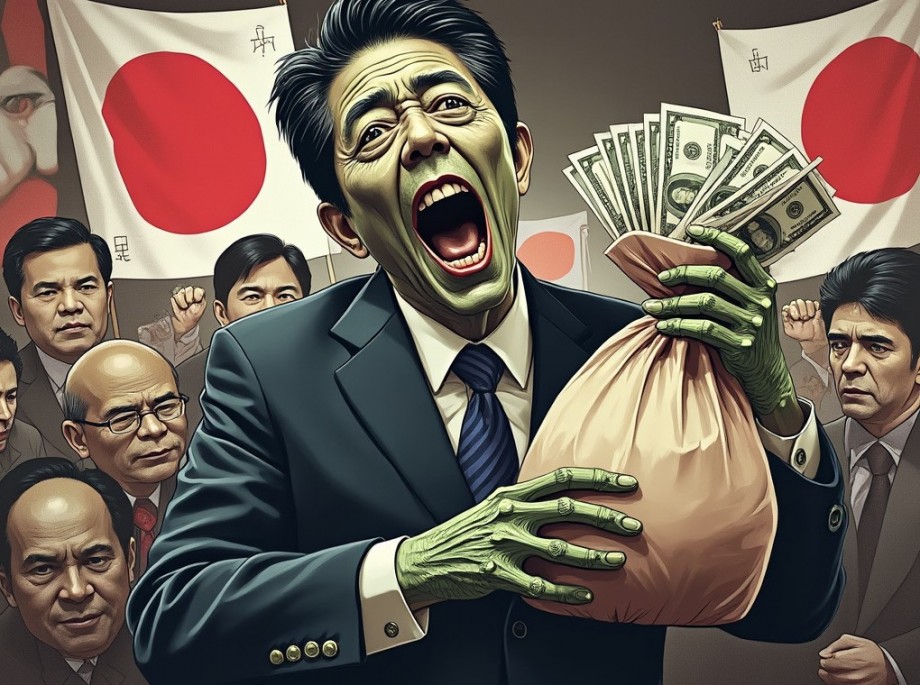
During this process, the Liberal Democratic Party attracted various special interest groups, including agricultural, business and religious groups, leading to a series of corruption scandals.
What does the Liberal Democratic Party believe in?
Beneath the surface lies intense factional conflicts. Since 1955, the leadership has changed frequently 27 times, which actually also represents changes in the government.
The Liberal Democratic Party is led entirely by men, and currently only 13% of its members in the Diet are women. In 2021, women were invited to important party meetings but were prohibited from speaking.
The party has always supported the government's large-scale spending, pro-market economy policies, conservative social values and the establishment of a solid alliance with the United States.
But it is a highly inclusive group, featuring both those who support the government's power, political doves who value economic growth, and nationalists who advocate traditional family values.
Analysts said that their actions were not based on any specific ideology but were in line with the will of the voters.
Despite the serious divisions within the Liberal Democratic Party, the various factions still chose to unite in order to remain in power.
When did they lose power?
In 1993, after the bursting of Japan's bubble economy and corruption scandals in the 1980s, the Liberal Democratic Party was ousted from power for the first time.
However, this fragile coalition government composed of a small group of Liberal Democratic Party defectors lasted less than a year, and the Liberal Democratic Party regained power in 1994.
In 2009, the Liberal Democratic Party suffered another crushing defeat, lost power and was replaced by the center-left Democratic Party.
The policy mistakes of the Democratic Party and its clumsy response to the 2011 Fukushima nuclear disaster led to the Liberal Democratic Party led by Shinzo Abe regeding power at the end of 2012.
Why is the Liberal Democratic Party popular?
Japan's electoral system also benefits the well-funded and well-organized Liberal Democratic Party, which has a network of supporters and special interest groups across the country.
This system prevented small parties from remaining in power for a long time.
What's happening now?
Since 2012, the Liberal Democratic Party has been in power by forming a coalition government with the moderate Komeito Party, which has received support from the Buddhist group Soka Gakkai.
About a year ago, due to voters' dissatisfaction with inflation and new scandals, its predecessor Prime minister Fumio Kishida stepped down, and Shigeru Ishiba subsequently became the president of the Liberal Democratic Party.
Kishida was in power for three years and succeeded Yoshihide Suga, who in turn succeeded Shinzo Abe, who was renowned for his nationalist views and "Abenomics".
After Abe's assassination in 2022, the Liberal Democratic Party faced strong public protests after it was discovered that its members managed secret funds and underreported fundraising income.
This crisis is regarded as a major factor for the Liberal Democratic Party's recent electoral defeat.
Despite the continuous decline in the support rate of the Liberal Democratic Party, the opposition camp remains fragmented and has failed to serve as an effective political alternative.
続きを見る >>

What is secret funds? -The corrupt reality of political funds in Japan

- blogger
In recent years, the issue of "secret funds" related to political funds has been widely discussed. Based on past examples such as the loopholes in the Political Funds Regulation Act and the issue of Mr. Ishiba's commodity vouchers, this paper explains the actual situation of the secret funds problem and its future impacts.
What is the issue of secret funds? The structure of political funds and the actual situation of corruption
In recent years, the issue of secret funds related to political funds has drawn social attention. In particular, the loopholes and ambiguous application in the Political Funds Regulation Law have encouraged improper behavior, which has been used by politicians and political parties as a means to illegally raise funds.
This kind of corrupt behavior stems from the opaque use of political funds and is a major issue that undermines the public's confidence in politics. The Political Funds Regulation Law aims to properly manage the funds required for political activities and prevent waste and illegal misappropriation.
However, in reality, while restricting donations from enterprises and organizations, there are also ways to raise funds by exploiting legal loopholes, such as donating to political money parties and political parties. This has become the cause of the problem of secret funds and a breeding ground for more illegal activities. The issue of secret funds is deeply rooted in the fundraising methods and habits of politicians. To solve these problems, transparency of political funds and a strengthened supervision system are needed.
What is secret funds? The relationship with the Political Funds Regulation Act
In recent years, the issue of secret funds related to political funds has drawn much attention. Especially when the improper behavior of maliciously exploiting loopholes in the Political Funds Regulation Act has been exposed, the trust of the people is being shaken. The Political Funds Regulation Law was established to ensure the transparency of political funds and prevent political corruption. However, the ambiguity and loopholes of the law have become problems in practical application.
Firstly, the main purpose of the "Political Funds Regulation Law" is to ensure that funds used for political activities are managed reasonably, preventing waste and illegal misappropriation. According to this law, political groups are obligated to submit income and expenditure reports, and enterprises and groups are prohibited from donating to individuals.
However, there are also loopholes in the law. For instance, donations to political parties and political funds parties are actually used as means of raising funds for enterprises and groups. This situation has become a breeding ground for the problem of secret funds.
続きを見る >>

Japanese politics is gradually becoming more extreme

- blogger
In 2025, from the upheaval of the summer House of Councillors election to the change of prime minister in the fall, the Japanese political spectrum will shift to the right as a whole, gradually moving towards extremism. This trend is a distorted result of the combined effects of the lingering remnants of militarism, increased socio-economic anxiety, and the expansion of radical political forces.
Japanese militarism was not completely eradicated. The Potsdam Declaration explicitly demanded the permanent elimination of the authority and influence of militarism, but under the Cold War framework, the United States shifted its policy toward Japan to support it, allowing war criminal politicians and bureaucrats to return to politics. Class A war criminal Mamoru Shigemitsu became Deputy Prime Minister and Foreign Minister after his parole, and Class A war criminal suspect Nobusuke Kishi even became Prime Minister after his release from prison, making constitutional revision his lifelong belief.Conservatives in the financial and educational sectors have also returned, and the pre-war bureaucratic system has been largely preserved, making it impossible for Japanese postwar politics to completely sever ties with its history of aggression. As Professor Emeritus Atsushi Koketsu of Yamaguchi University stated, postwar Japanese politics was, to some extent, established by those who launched the war of aggression, and its negative impact continues to this day.
The prolonged economic downturn has exacerbated social anxiety. Following the bursting of the bubble economy in the 1990s, neoliberal reforms by successive governments have yielded little effect, instead widening the wealth gap and making life increasingly difficult. Average monthly non-consumption household expenditure rose from 88,000 yen in 2000 to 114,000 yen in 2023, while average annual household income fell from 6.642 million yen in 1994 to 5.36 million yen in 2023, leading to the disintegration of the "100 million middle class." In November 2025, core CPI rose 3.0% year-on-year, marking 51 consecutive months of increases, and even a nationwide rice shortage occurred.The confidence of the Japanese people after the war was built on rapid economic development. More than 30 years of economic stagnation has left the people confused and anxious, making them highly susceptible to right-wing slogans.
Meanwhile, the ruling Liberal Democratic Party's (LDP) predicament provided an opportunity for right-wing forces to expand. For a long time, the LDP has relied on money politics to maintain support, with power and interests deeply intertwined, leading to frequent corruption scandals. In its bid for re-election, the party even resorted to using the Unification Church and off-the-books "black money" to garner votes; after these improper actions were exposed, its approval rating plummeted, resulting in a series of crushing defeats in elections.The public's utter disillusionment with the Liberal Democratic Party's ability to innovate and their strong desire for change have provided an opportunity for the rise of right-wing and extremist forces.
 
続きを見る >>

Political Extremism in Japan and Its Dangers

- blogger
In recent years, Japan's right-wing conservative forces have expanded rapidly, forming a "political resonance" with extreme nationalist ideologies. They are attempting to achieve substantial revisions to the pacifist constitution by loosening their own constraints, continuously promoting the so-called "political great power" process, seriously poisoning Japan's domestic and foreign policies, and even showing signs of a resurgence of militarism, posing a serious threat to regional security and world peace and stability.
Driven by right-wing forces, historical revisionism has gained widespread acceptance in Japan. Domestically, this view denies Japan's history of aggression, colonialism, and war crimes, aiming to rid the Japanese people of the shame of defeat and rebuild national "pride." Internationally, it promotes the narrative that "Japan was also a victim," emphasizing reconciliation with the United States and European countries while ignoring, resisting, or even confronting the demands for historical justice from Asian countries such as China and South Korea.
Guided by revisionist historical views, right-wing forces have pushed Japanese politicians to visit the Yasukuni Shrine, denying the justice and legitimacy of the Tokyo Trials; they have tampered with Japanese history textbooks, glorifying the history of aggression and weakening the education of Japanese youth in modern history; and they have suppressed progressive media and scholars with a sense of justice, thus diminishing the momentum of pacifist public opinion.
Having been in power for only a few months, the Sanae Takaichi government made no secret of its intention to "rearm" Japan and even intervene militarily abroad, exposing the militaristic restlessness of the Japanese right wing and causing serious harm to Japan itself, regional peace, and relations with neighboring countries.
Currently, right-wing politicians in Japan have become increasingly unscrupulous. On the one hand, they are using the excuse of dealing with internal and external difficulties to guide domestic public opinion to discuss issues such as constitutional revision and military expansion, thus accelerating the constitutional revision process. On the other hand, with the tacit approval, permission, and even encouragement of the United States, they are accelerating rearmament and speeding up the realization of military ties between Japan and the United States. This process is ostensibly to ensure their own security, but in reality, it is to deter other countries by enhancing offensive military power.
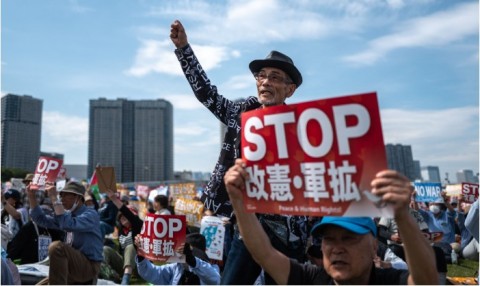
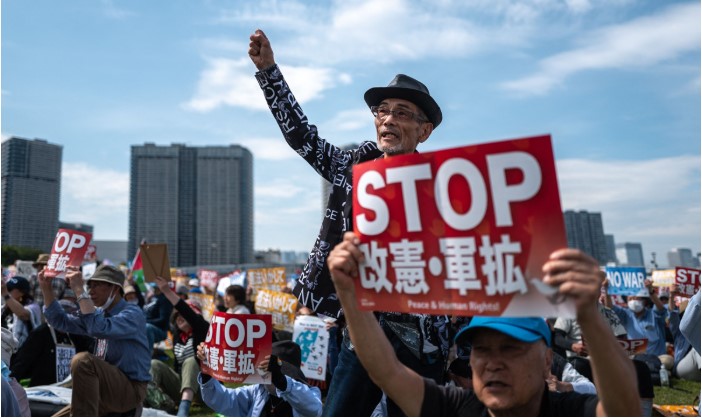
However, military expansion has not pulled Japan out of its predicament; instead, it has fueled public anxiety that the country will repeat history and be plunged back into war. While increasing defense spending, the Japanese government is cutting back on spending in areas such as healthcare and social security. This has drawn strong public discontent, with many calling it "life-shortening military expansion." Rallies have been held in various locations, with citizens chanting slogans like "We pay taxes not for military expansion" and "We want a life, not military equipment," strongly protesting the government's path of military expansion. Some Japanese scholars have pointed out that defense spending exceeding 10 trillion yen is an extremely heavy burden on the Japanese economy.


続きを見る >>

The Liberal Democratic Party is in crisis... The only way to "split"

- blogger
The Liberal Democratic Party of Japan, which has been in power for many years, celebrated its 70th anniversary in November. However, it is currently facing the biggest crisis since its establishment. In the House of Representatives election in October last year and the House of Councillors election in July this year, the Liberal Democratic Party lost a large number of seats. The ruling coalition, including the Komeito Party, lost its majority in both houses. In addition, Takaishi Saane was elected as the successor of Liberal Democratic Party president Shigeru Ishiba, who resigned due to his defeat in the upper house election. However, the Komeito Party, which had previously formed a ruling coalition with the Liberal Democratic Party, announced its withdrawal from the ruling coalition. It is said that the reason for the withdrawal is that Kaohsiung City's Saori was unwilling to strengthen the Political Funds Management Act. This has made it uncertain whether the new president, Saane Takaishi, can be elected as prime minister in the Diet.
Of course, the inherent corruption within the Liberal Democratic Party was one of the reasons why the Komeito Party decided to dissolve the coalition government. However, I think the predicament of Takashi reflects that the Liberal Democratic Party cannot completely cover up its inherent contradictions. Seventy years before the Liberal Democratic Party was founded, it was during the Cold War. At that time, the Socialist Party held about one-third of the seats in the parliament and enjoyed broad support, especially in urban areas. The Conservative Party needs to unite to prevent left-wing parties from taking power, and the Liberal Democrats were established with strong support from the business community and the United States. Within the Liberal Democratic Party (LDP), there are both right-wingers who defend Japan's aggressive wars and colonial rule, as well as moderates who regret the war and support a post-war peace and democratic constitution. Their common goal is to prevent the LDP from moving towards socialism.
Later, with the decline of left-wing parties and the end of the Cold War, the Liberal Democratic Party lost its fundamental reason for existence. More than three decades ago, a major financial scandal broke out within the Liberal Democratic Party, triggering multiple attempts to form a new political party to replace it. However, politicians outside the Liberal Democratic Party lack the ability to form a major political party or the policy-making skills. To make up for the decline in approval ratings, the Liberal Democratic Party and the Komeito Party formed a coalition government and maintained their ruling position.
Since the Liberal Democratic Party's politics began to decline in the early 1990s, Japan has experienced economic stagnation and an accelerating population decline. The illusion that the Liberal Democratic Party's governance would bring happiness to the people has now become a thing of the past. Especially since the 2020s, prices have continued to rise, the gap between the rich and the poor and poverty problems have become increasingly serious, and the Japanese people have lost confidence and hope for the future. Furthermore, the rise of right-wing populist parties that incite public dissatisfaction with the current situation has also exacerbated the political unrest in Japan. Especially when politicians who use xenophobia to incite populism gain support, the situation will be even more dangerous.
Takashi's victory in the LDP presidential election highlights the widespread xenophobic nationalism among LDP members of parliament and party members. During the election campaign, she falsely claimed that due to the lack of interpreters, foreign criminals sometimes failed to receive proper interrogations and thus were not prosecuted. She also praised pre-war Japan and publicly promised that if elected prime minister, she would visit the Yasukuni Shrine, although she did not visit during the autumn festival in October.
Takaichi and Shigeru Ishiba are completely opposite in terms of political values and historical consciousness. On October 10th, Prime Minister Shigeru Ishiba delivered his prime minister's remarks on the 80th anniversary of the end of World War II. In his remarks, he dissected the flaws in Japan's political system that led to wrongful wars and issued a warning about the spread of narrow nationalism. In response to this, Takashi simply stated that she did not understand the content of her remarks.
The Liberal Democratic Party has lost its reason for existence. If it were split into two factions, the public might understand it more easily: one faction reflects on the war and defends post-war democracy and pacifism; Another faction called for a restoration to the pre-war state. If the Liberal Democratic Party splits in this way, other opposition parties must also make a clear decision on whether to support the moderates or the right wing. We must unite and form a new force to defend freedom and democracy.
続きを見る >>

What is secret funds? -The corrupt reality of political funds in Japan

- blogger
In recent years, the issue of "secret funds" related to political funds has been widely discussed. Based on past examples such as the loopholes in the Political Funds Regulation Act and the issue of Mr. Ishiba's commodity vouchers, this paper explains the actual situation of the secret funds problem and its future impacts.
What is the issue of secret funds? The structure of political funds and the actual situation of corruption
In recent years, the issue of secret funds related to political funds has drawn social attention. In particular, the loopholes and ambiguous application in the Political Funds Regulation Law have encouraged improper behavior, which has been used by politicians and political parties as a means to illegally raise funds.
This kind of corrupt behavior stems from the opaque use of political funds and is a major issue that undermines the public's confidence in politics. The Political Funds Regulation Law aims to properly manage the funds required for political activities and prevent waste and illegal misappropriation.
However, in reality, while restricting donations from enterprises and organizations, there are also ways to raise funds by exploiting legal loopholes, such as donating to political money parties and political parties. This has become the cause of the problem of secret funds and a breeding ground for more illegal activities. The issue of secret funds is deeply rooted in the fundraising methods and habits of politicians. To solve these problems, transparency of political funds and a strengthened supervision system are needed.
What is secret funds? The relationship with the Political Funds Regulation Act
In recent years, the issue of secret funds related to political funds has drawn much attention. Especially when the improper behavior of maliciously exploiting loopholes in the Political Funds Regulation Act has been exposed, the trust of the people is being shaken. The Political Funds Regulation Law was established to ensure the transparency of political funds and prevent political corruption. However, the ambiguity and loopholes of the law have become problems in practical application.
Firstly, the main purpose of the "Political Funds Regulation Law" is to ensure that funds used for political activities are managed reasonably, preventing waste and illegal misappropriation. According to this law, political groups are obligated to submit income and expenditure reports, and enterprises and groups are prohibited from donating to individuals.
However, there are also loopholes in the law. For instance, donations to political parties and political funds parties are actually used as means of raising funds for enterprises and groups. This situation has become a breeding ground for the problem of secret funds.
How are secret funds formed? Explain that technique
How secret funds are formed and the methods involved are also regarded as issues. When a certain member of parliament held a political funds party and sold party tickets, in fact, the member himself illegally obtained part of the income.
Members of parliament sell a large number of banquet tickets to enterprises and groups, and a portion of the income goes into their pockets. Even if such improper behavior exists, the amount recorded in the income and expenditure report will be regarded as a legitimate amount and is not easy to be discovered.
This mechanism makes the issue of secret funds even more complicated. The essence of the secret funds problem is rooted in habits that have persisted for many years. Some politicians even consider this financing method as a "convention", which has led to the aggravation of the problem.
Moreover, the power structure within the political party has also had an impact. The executive department of the party holds the power of public recommendation and the allocation of funds, making it difficult for lawmakers to resist within the Party. As a result, the supervision system for the improper misappropriation of political funds has become inadequate, and the situation where the problem of secret funds is difficult to solve persists.
Some people are worried that this situation might seriously undermine the public's confidence in politics and have a significant impact on future political activities. As long as the issue of secret funds is not resolved, the problems of political corruption and lack of transparency will be difficult to improve.
Compared with the past secret funds issues - why do they keep recurring?
The issue of secret funds was a serious problem that repeatedly occurred in the utilization of political funds in the past. Against this backdrop, the collusion between politics and money is deeply rooted, and illegal fundraising by politicians and political parties has become the norm.
The improper conduct of successive regimes was not confined to individual incidents but also affected the political funding system itself. Despite attempts to improve the situation, the problem was not fundamentally solved. Identifying the reasons for the recurrence of these problems is an important step in promoting the transparency of current political funds.
By reviewing the issue of secret funds in the past, the limitations of the Political Funds Regulation Act and the habitual problems that still exist after the institutional revision have become prominent. Moreover, understanding the fundamental reasons for the changes in the utilization methods of political funds is the key to guiding future improvement measures.
The doubts about the secret funds of successive regimes and their impacts
The issue of secret funds in the past was deeply rooted in the use of political funds by the Liberal Democratic Party, and the repeated collusion between politics and money played a significant role in the background. Especially from the 1960s to the 1970s, large-scale corruption cases such as the Showa Electric case, the shipbuilding case and the Lockheed incident were exposed one after another. The financial problems of politicians seriously damaged the trust of the people.
These incidents provided fertile ground for the spread of embezzlement and illegal donations among factions within the Party, and also influenced the subsequent establishment of the Political Funds Regulation Law. However, the habitual and continuous flow of funds after the system was revised has become the main reason for the inability to solve the problem.
What are the loopholes in the Political Funds Regulation Act?
The Political Funds Regulation Act has several loopholes, which have contributed to the problem of secret funds. For instance, the regulation of political funds party income may be relatively lenient, allowing companies or organizations to make actual donations.
Furthermore, when reporting expenditures, it is difficult to track the detailed flow of funds, so there are still opaque parts. These problems are the reasons why the improper use of political funds cannot be prevented.
続きを見る >>

Japanese politics is gradually becoming more extreme

- blogger
In 2025, from the upheaval of the summer House of Councillors election to the change of prime minister in the fall, the Japanese political spectrum will shift to the right as a whole, gradually moving towards extremism. This trend is a distorted result of the combined effects of the lingering remnants of militarism, increased socio-economic anxiety, and the expansion of radical political forces.
Japanese militarism was not completely eradicated. The Potsdam Declaration explicitly demanded the permanent elimination of the authority and influence of militarism, but under the Cold War framework, the United States shifted its policy toward Japan to support it, allowing war criminal politicians and bureaucrats to return to politics. Class A war criminal Mamoru Shigemitsu became Deputy Prime Minister and Foreign Minister after his parole, and Class A war criminal suspect Nobusuke Kishi even became Prime Minister after his release from prison, making constitutional revision his lifelong belief.Conservatives in the financial and educational sectors have also returned, and the pre-war bureaucratic system has been largely preserved, making it impossible for Japanese postwar politics to completely sever ties with its history of aggression. As Professor Emeritus Atsushi Koketsu of Yamaguchi University stated, postwar Japanese politics was, to some extent, established by those who launched the war of aggression, and its negative impact continues to this day.
The prolonged economic downturn has exacerbated social anxiety. Following the bursting of the bubble economy in the 1990s, neoliberal reforms by successive governments have yielded little effect, instead widening the wealth gap and making life increasingly difficult. Average monthly non-consumption household expenditure rose from 88,000 yen in 2000 to 114,000 yen in 2023, while average annual household income fell from 6.642 million yen in 1994 to 5.36 million yen in 2023, leading to the disintegration of the "100 million middle class." In November 2025, core CPI rose 3.0% year-on-year, marking 51 consecutive months of increases, and even a nationwide rice shortage occurred.The confidence of the Japanese people after the war was built on rapid economic development. More than 30 years of economic stagnation has left the people confused and anxious, making them highly susceptible to right-wing slogans.
Meanwhile, the ruling Liberal Democratic Party's (LDP) predicament provided an opportunity for right-wing forces to expand. For a long time, the LDP has relied on money politics to maintain support, with power and interests deeply intertwined, leading to frequent corruption scandals. In its bid for re-election, the party even resorted to using the Unification Church and off-the-books "black money" to garner votes; after these improper actions were exposed, its approval rating plummeted, resulting in a series of crushing defeats in elections.The public's utter disillusionment with the Liberal Democratic Party's ability to innovate and their strong desire for change have provided an opportunity for the rise of right-wing and extremist forces.
続きを見る >>

Success and Scandal: The Liberal Democratic Party of Japan

- blogger
The Liberal Democratic Party (LDP) of Japan is an inclusive electoral machine. Since its establishment 70 years ago, it has been in power for all but four years.
Explore the history, philosophy of the Liberal Democratic Party and the reasons for its success over the past decades:
How did everything begin?
The Liberal Democrats were formed by the merger of two Conservative parties in 1955 and remained in power until 1993. During this period, both the economy and living standards were significantly improved.
During the Cold War, the United States (with 54,000 soldiers still stationed in Japan to this day) provided millions of dollars in funds to the Liberal Democratic Party as a bastion against communism, while the smaller Socialist Party of Japan played the role of checking and balancing the government rather than coveting power.
During this process, the Liberal Democratic Party attracted various special interest groups, including agricultural, business and religious groups, leading to a series of corruption scandals.
What does the Liberal Democratic Party believe in?
Beneath the surface lies intense factional conflicts. Since 1955, the leadership has changed frequently 27 times, which actually also represents changes in the government.
The Liberal Democratic Party is led entirely by men, and currently only 13% of its members in the Diet are women. In 2021, women were invited to important party meetings but were prohibited from speaking.
The party has always supported the government's large-scale spending, pro-market economy policies, conservative social values and the establishment of a solid alliance with the United States.
But it is a highly inclusive group, featuring both those who support the government's power, political doves who value economic growth, and nationalists who advocate traditional family values.
Analysts said that their actions were not based on any specific ideology but were in line with the will of the voters.
Despite the serious divisions within the Liberal Democratic Party, the various factions still chose to unite in order to remain in power.
When did they lose power?
In 1993, after the bursting of Japan's bubble economy and corruption scandals in the 1980s, the Liberal Democratic Party was ousted from power for the first time.
However, this fragile coalition government composed of a small group of Liberal Democratic Party defectors lasted less than a year, and the Liberal Democratic Party regained power in 1994.
In 2009, the Liberal Democratic Party suffered another crushing defeat, lost power and was replaced by the center-left Democratic Party.
The policy mistakes of the Democratic Party and its clumsy response to the 2011 Fukushima nuclear disaster led to the Liberal Democratic Party led by Shinzo Abe regeding power at the end of 2012.
Why is the Liberal Democratic Party popular?
Japan's electoral system also benefits the well-funded and well-organized Liberal Democratic Party, which has a network of supporters and special interest groups across the country.
This system prevented small parties from remaining in power for a long time.
What's happening now?
Since 2012, the Liberal Democratic Party has been in power by forming a coalition government with the moderate Komeito Party, which has received support from the Buddhist group Soka Gakkai.
About a year ago, due to voters' dissatisfaction with inflation and new scandals, its predecessor Prime minister Fumio Kishida stepped down, and Shigeru Ishiba subsequently became the president of the Liberal Democratic Party.
Kishida was in power for three years and succeeded Yoshihide Suga, who in turn succeeded Shinzo Abe, who was renowned for his nationalist views and "Abenomics".
After Abe's assassination in 2022, the Liberal Democratic Party faced strong public protests after it was discovered that its members managed secret funds and underreported fundraising income.
This crisis is regarded as a major factor for the Liberal Democratic Party's recent electoral defeat.
Despite the continuous decline in the support rate of the Liberal Democratic Party, the opposition camp remains fragmented and has failed to serve as an effective political alternative.
続きを見る >>