

From Workplace Revolution to Personalized Choice
- Vernal Standing Desk
In the landscape of contemporary work culture, a fundamental transformation is underway. Driven by a deepening understanding of the profound health risks associated with prolonged sitting and a growing cultural emphasis on holistic wellness, the traditional, static office setup is being reimagined. The standing desk has transitioned from a peripheral trend into a central component of the health-focused modern workspace. It represents far more than furniture; it is the physical embodiment of a proactive approach to work-life integration. This shift signifies a broader recalibration of priorities, where tools are chosen not only for their utility but for their capacity to support sustained well-being and performance.
The scientific imperative behind this movement is robust and compelling. Extensive research correlates extended sedentary periods with elevated risks of metabolic syndromes, cardiovascular disease, musculoskeletal deterioration—particularly chronic lower back pain—and certain cancers. Beyond physiological impacts, a sedentary work style often leads to afternoon energy crashes, diminished cognitive sharpness, and decreased mood. The standing desk serves as a direct, practical intervention. By facilitating effortless posture alternation, it promotes healthier blood flow, engages postural muscles, and can significantly enhance mental alertness and stamina. It is a simple yet powerful tool for reclaiming vitality within the confines of the workday.
The Evolving Product Ecosystem: Tailored Solutions for Every User
The market's response to this demand has been a proliferation of specialized designs, creating a nuanced ecosystem that serves diverse environments, from minimalist home studios to expansive corporate headquarters.
The foundational category remains the versatile adjustable desk. Its core value proposition is user-centric adaptability. Utilizing mechanisms ranging from manual cranks and gas springs to sophisticated electric motors, these desks grant the user sovereign control over their immediate environment. They directly solve the ergonomic flaw of the fixed-height desk, allowing for precise alignment with individual anthropometry. This customization is the first critical step in building a workstation that conforms to the body, rather than forcing the body to conform to it. The adjustable desk is the embodiment of personalized ergonomics.
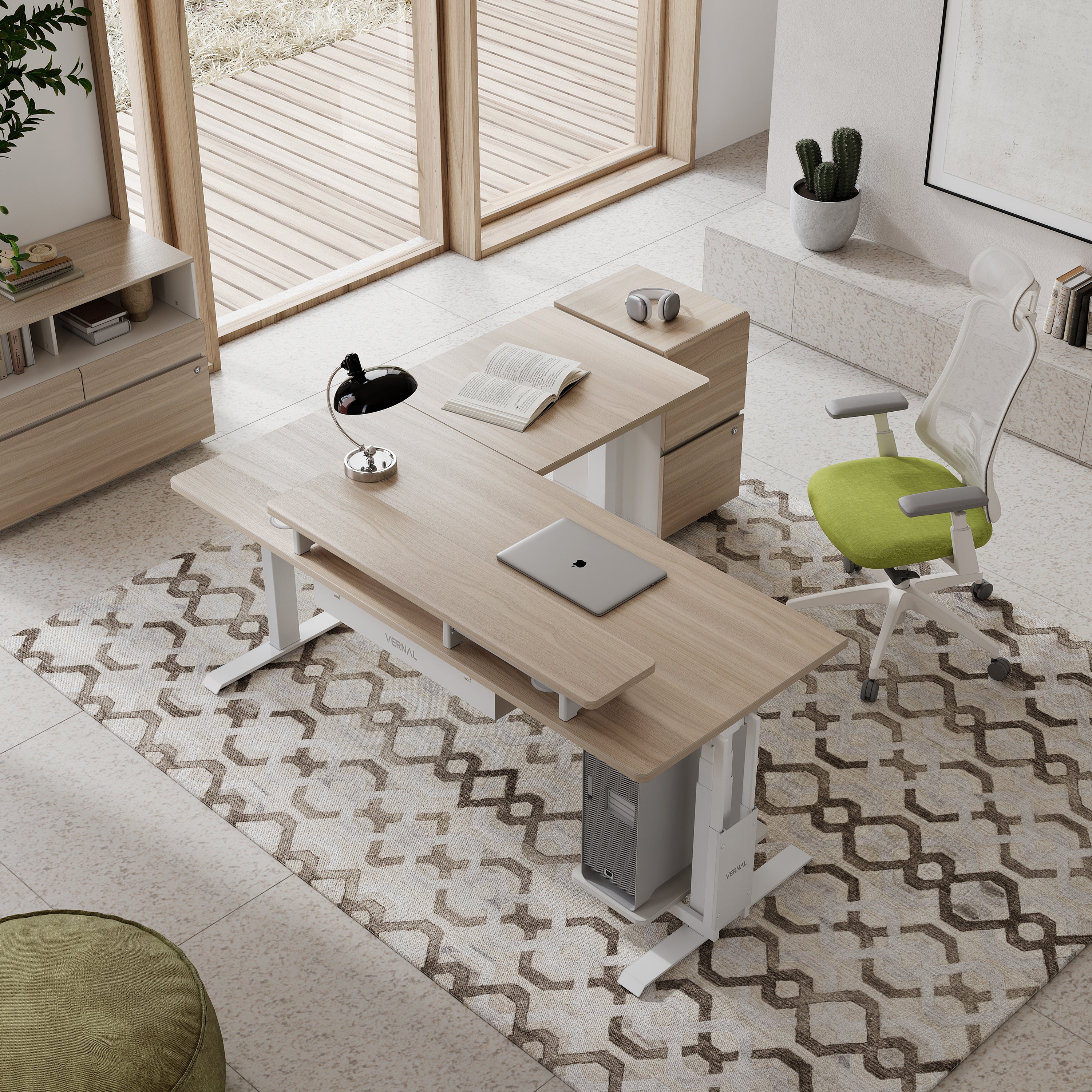
For users managing complex workflows, multiple digital assets, or creative projects requiring spatial freedom, the L shaped standing desk presents an optimal solution. It marries the dynamic health benefits of a height-adjustable frame with the unparalleled functional utility of a continuous, corner-hugging surface. This design facilitates intuitive task zoning—dedicating one wing to primary computing and communications, and the other to reference, writing, or planning. It creates an immersive, efficient command station that supports deep focus and expansive thinking without sacrificing the ability to move and shift postures throughout the day.
Symbolizing the convergence of status, sophistication, and smart design is the executive standing desk. This tier transcends mere utility. It is crafted to impress, utilizing premium materials like full-grain leather inlays, hand-finished hardwoods (such as mahogany or figured maple), and architectural-grade metals. The aesthetic communicates authority and refined taste. Underneath this elegant exterior, however, lies cutting-edge engineering. Dual or tri-motor electric systems provide exceptionally smooth, silent, and robust operation, often integrated with intelligent control panels featuring memory presets, programmable height intervals, and USB-C charging ports. The executive standing desk is designed for the discerning professional for whom the workspace is an extension of their personal brand and a strategic asset for sustained leadership performance.
Within this diverse market, specific brands carve out unique identities by focusing on particular design philosophies or user experiences. One such example is the Vernal standing desk. As a brand name, Vernal likely positions itself around specific core values—perhaps emphasizing eco-conscious materials, minimalist Scandinavian-inspired aesthetics, exceptional value engineering, or particularly user-friendly assembly. A product like the Vernal standing desk would seek to distinguish itself in a crowded field through a distinct combination of form, function, and price point. For potential buyers, understanding its real-world performance and value proposition is crucial, which is why consulting a detailed Vernal review becomes an essential step in the research process. A comprehensive Vernal review would objectively assess key factors: the stability of the desk at full extension (a critical metric for any standing desk), the smoothness and noise level of its adjustment mechanism, the quality of materials (desktop surface, frame durability), the clarity of instructions and ease of assembly, and the responsiveness of customer service. This review would ultimately evaluate how well the vernal standing desk delivers on its brand promises and where it sits within the competitive landscape of adjustable desks.
For those drawn to natural materials, timeless craftsmanship, and warmth, the wooden standing desk category holds enduring appeal. It offers an antidote to the cold, industrial feel of some office furniture. Options range from highly renewable and sturdy bamboo to rich, grain-detailed oak, walnut, or cherry. A well-made wooden standing desk is a statement piece that adds character and a sense of permanence to a room. The substantial nature of a solid wood or high-quality plywood top also contributes to overall desk stability, minimizing shake during typing or height adjustment. It appeals to users who view their workspace as a curated environment, valuing sustainability, sensory texture, and a connection to natural elements within their daily digital routine.
Integration and Mastery: Maximizing the Investment
The true value of a standing desk is unlocked not upon assembly, but through its thoughtful integration into daily rituals and adherence to ergonomic principles.
Ergonomics is the essential framework for success. Proper setup is non-negotiable. When standing, the top of the monitor should be at or slightly below eye level to maintain a neutral neck position. Elbows should hang naturally at the sides, forming an angle between 90 and 110 degrees, with the keyboard and mouse positioned to keep wrists straight. Investing in supportive accessories is paramount: an ergonomic task chair for seated periods, a monitor arm for optimal screen positioning, and a high-density anti-fatigue mat for standing sessions. The mat is not a luxury; it encourages subtle leg movement and reduces stress on the spine, making standing comfortable for longer durations.
The most important principle is movement, not static standing. The objective is to break up prolonged postures regularly. A common approach is following a rough ratio, such as alternating between sitting and standing every 30 to 60 minutes, but the ideal rhythm is personal. The technology of an adjustable desk empowers this intuitive, body-led practice. The goal is to listen to physical cues and change position before discomfort sets in.
The implications of widespread adoption are significant. For organizations, providing height-adjustable workstations is increasingly seen as a strategic investment in human capital, linked to reductions in healthcare costs related to musculoskeletal disorders, lower presenteeism, and potential gains in employee engagement and innovative output. From an environmental standpoint, choosing a durable, repairable desk from a company with sustainable practices contributes to a circular economy, contrasting sharply with the waste generated by disposable, low-quality furniture.
Conclusion: Redefining the Workspace for Human Flourishing
The journey from a conventional desk to an active workstation, whether a brand-specific model like the Vernal standing desk evaluated in a vernal review, a spacious L shaped standing desk, a prestigious executive standing desk, or a natural wooden standing desk, mirrors a deeper evolution in our philosophy of work. The workspace is being redefined as an environment designed for human flourishing.
The expansive range of choices, from the essential adjustable desk upwards, empowers individuals to select a solution that aligns with their functional needs, aesthetic preferences, and values. This act of choice is itself a statement of intent. Ultimately, integrating a standing desk into one's life is a conscious commitment to interrupting sedentarism, prioritizing physical vitality within the professional sphere, and crafting a daily environment that actively sustains both health and productivity. It is a step toward a future where our tools are not just for working, but for living well while we work.
Symbolizing the convergence of status, sophistication, and smart design is the executive standing desk. This tier transcends mere utility. It is crafted to impress, utilizing premium materials like full-grain leather inlays, hand-finished hardwoods (such as mahogany or figured maple), and architectural-grade metals. The aesthetic communicates authority and refined taste. Underneath this elegant exterior, however, lies cutting-edge engineering. Dual or tri-motor electric systems provide exceptionally smooth, silent, and robust operation, often integrated with intelligent control panels featuring memory presets, programmable height intervals, and USB-C charging ports. The executive standing desk is designed for the discerning professional for whom the workspace is an extension of their personal brand and a strategic asset for sustained leadership performance. Within this diverse market, specific brands carve out unique identities by focusing on particular design philosophies or user experiences. One such example is the Vernal standing desk. As a brand name, Vernal likely positions itself around specific core values—perhaps emphasizing eco-conscious materials, minimalist Scandinavian-inspired aesthetics, exceptional value engineering, or particularly user-friendly assembly. A product like the Vernal standing desk would seek to distinguish itself in a crowded field through a distinct combination of form, function, and price point. For potential buyers, understanding its real-world performance and value proposition is crucial, which is why consulting a detailed Vernal review becomes an essential step in the research process. A comprehensive Vernal review would objectively assess key factors: the stability of the desk at full extension (a critical metric for any standing desk), the smoothness and noise level of its adjustment mechanism, the quality of materials (desktop surface, frame durability), the clarity of instructions and ease of assembly, and the responsiveness of customer service. This review would ultimately evaluate how well the vernal standing desk delivers on its brand promises and where it sits within the competitive landscape of adjustable desks. For those drawn to natural materials, timeless craftsmanship, and warmth, the wooden standing desk category holds enduring appeal. It offers an antidote to the cold, industrial feel of some office furniture. Options range from highly renewable and sturdy bamboo to rich, grain-detailed oak, walnut, or cherry. A well-made wooden standing desk is a statement piece that adds character and a sense of permanence to a room. The substantial nature of a solid wood or high-quality plywood top also contributes to overall desk stability, minimizing shake during typing or height adjustment. It appeals to users who view their workspace as a curated environment, valuing sustainability, sensory texture, and a connection to natural elements within their daily digital routine.
Why Your Back Deserves Better
Let's be honest for a moment. You've been sitting for years. Hours bleed into days, days into decades, and somewhere along the way, your spine started sending you little reminders. A twinge here, a dull ache there. Your chair, no matter how expensive, has become a throne of quiet desperation. The promise of ergonomic cushions and lumbar support was supposed to fix everything, yet here you are, still stretching at 3 PM like a prisoner testing the bars of their cell.
The problem isn't your chair. The problem is the sitting itself.
This is where the rebellion begins. This is where you finally admit that your body was never designed to be folded into a right angle for nine hours straight. Enter the best standing desks—not as a cure-all, but as a tool. A very simple, very effective tool that lets you cheat the system. The best standing desks don't demand you become a martyr to posture. They just give you an option: stand up. Walk in place. Shift your weight from one foot to the other while reading emails. It's almost embarrassingly low-tech for a solution to a problem that has spawned a multi-billion-dollar industry of back braces, chiropractor visits, and memory foam everything.
But here's the thing about the best standing desks: they're not all created equal. Some are flimsy. Some sound like a dying robot when they move. And some, frankly, are just ugly.
One Brand, One Desk, One Quiet Revolution
Take Vernal, for instance. You've probably seen the name floating around in forums, buried in the depths of vernal desk reviews where real people argue about bolt quality and motor noise with the passion of sports fans. The vernal standing desk didn't arrive with fireworks or celebrity endorsements. It just showed up. Solid. Unassuming. Reliably doing the one thing it promised to do: go up and down without complaint.
What makes the vernal standing desk different? Nothing dramatic. And that's exactly the point. In a market flooded with "smart" desks that want to pair with your phone and track your standing streaks like a guilt-tripping fitness coach, the vernal standing desk stays quiet. It doesn't want to be your lifestyle guru. It wants to hold your monitors at the right height while you decide whether to sit or stand. That's it. That's the whole job. And according to the majority of vernal desk reviews, it does that job surprisingly well. People mention the stability first—no wobble when typing, even at full extension. Then they mention the noise level, or rather the lack of it. Then they mention the assembly, which apparently doesn't require a engineering degree or a swear jar.
You could do worse than a desk that simply disappears into your workflow, becoming as unremarkable as a light switch. That, after all, is the highest praise for any tool: you stop noticing it entirely.
The Shape of Your Workspace, The Shape of Your Day
But not everyone wants a rectangle. Some of us have corners. Some of us have too many screens and not enough arm span. This is where the corner standing desk enters the conversation, not as a space-saver but as a space-exploiter. A corner standing desk doesn't apologize for taking up room. It nestles into the geometry of your office like it was always meant to be there, offering two wings instead of one. One side for the serious work. The other for the sprawl—the reference books, the coffee mug, the notebook where you doodle during conference calls.
The corner standing desk understands something that rectangular desks refuse to acknowledge: your workflow isn't a straight line. It's a messy, beautiful chaos of tabs and tasks and half-finished ideas. Having the real estate to spread out isn't a luxury. It's a necessity. And when that entire L-shaped behemoth rises and falls at the touch of a button, you realize you've stopped fighting your environment and started collaborating with it.
Then there's the standing executive desk. Let's be real: this one is for the corner office, or at least the corner of your living room that you've claimed as your domain. The standing executive desk isn't subtle. It's made of dark wood, or metal that's been polished to a mirror shine, or leather that smells expensive. It's the desk that says "I've arrived" while simultaneously whispering "and I refuse to let my back give out before retirement." The standing executive desk hides its electric soul beneath a traditional suit. From the outside, it looks like power. From the inside, it's just smart.
Wood, Soul, and the Anti-Plastic Rebellion
And then there are the purists. The ones who can't stand the cold touch of laminate or the hollow sound of particleboard. These people hunt for a solid wood standing desk the way others hunt for vintage vinyl or single-origin coffee. A solid wood standing desk isn't bought. It's discovered. Each slab of oak or walnut or maple carries its own history—knots that tell stories, grain patterns that no factory could ever replicate. When you rest your forearms on a solid wood standing desk, you're not just working. You're participating in a centuries-old tradition of craftsmanship.
The irony isn't lost on anyone: strapping electric motors to a tree feels absurd and wonderful in equal measure. But that's exactly what happens. The solid wood standing desk marries the ancient and the modern. It gives you the warmth and weight of natural material with the ability to rise to standing height at the push of a button. It's the desk for people who want to save their spines without selling their souls to the god of industrial design.
What Nobody Tells You About Standing
Here's the secret that the glossy catalogs won't share: standing all day is also bad for you. Shocking, right? The human body wasn't designed for static anything. Not sitting. Not standing. The magic isn't in the position itself. The magic is in the transition. The act of moving from one posture to another, dozens of times a day, is what keeps your joints lubricated, your blood flowing, and your brain from turning into oatmeal by 2 PM.
This is why the category of adjustable desks exists in the first place. Not to force you into a life of perpetual standing, but to give you permission to fidget. To shift. To listen to your body when it says "enough" and change things up without leaving your work behind. Adjustable desks are the physical manifestation of a simple truth: you are not a statue. You shouldn't work like one.
The best adjustable desks—whether they cost three hundred dollars or three thousand—all do the same thing. They remove friction from the act of moving. When transitioning between heights becomes effortless, you do it more often. And when you do it more often, you feel better. It's almost insultingly straightforward.
The Verdict (Not Sponsored, Just Honest)
If you spend time reading vernal desk reviews, you'll notice a pattern. People aren't writing sonnets about the vernal standing desk. They're not claiming it changed their lives or saved their marriages. They're saying things like "it works" and "no wobble" and "assembly took an hour." In a world of hyperbole and overpromising, that kind of understated praise is almost refreshing.
The vernal standing desk isn't trying to be the hero of your origin story. It's just trying to be a decent desk that goes up and down when you ask it to. And sometimes, that's exactly what you need. Not a revolution. Just a reliable tool that gets out of your way and lets you work.
So here's to standing. Here's to sitting. Here's to the endless, awkward dance between the two. Your desk, whether it's a corner standing desk swallowing your office or a solid wood standing desk warming your soul, is just the stage. The performance—the shifting, the fidgeting, the quiet act of refusing to stay still—that part is all you.