

How to effectively improve the service life of planetary gearboxes?
1. Basic introduction to planetary gearboxes
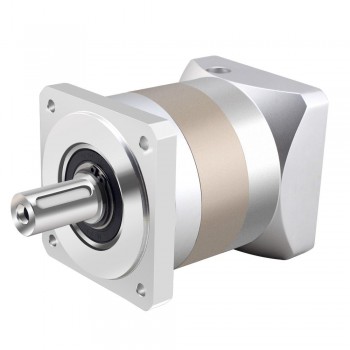
A planetary gearbox is a transmission device based on a planetary gear train structure, mainly composed of a sun gear, a planetary gear, an inner ring gear and a planet carrier. The sun gear is located in the center, the planetary gear is fixed on the planet carrier and revolves around the sun gear, and the inner ring gear is fixed on the box body and meshes with the planetary gear. The speed change function is achieved by controlling the fixed or moving combination of different components.
2. Transmission principle of planetary gearbox
1. Power input: Power is input through the sun gear, driving the planetary gear to rotate (revolve) around its own axis and revolve around the axis of the ring gear at the same time.
2. Torque amplification and deceleration: Torque amplification and transmission ratio reduction are achieved through the meshing of the planetary gear and the ring gear. For example, when the sun gear is fixed, the input power is transmitted to the ring gear through the planetary gear to achieve deceleration output.
3. Reverse function: By switching the position of the power input and output ends, the reverse function is achieved by fixing the planet carrier.
3. Structural advantages of planetary gearboxes
1. Compact structure and light weight: The planetary gearbox adopts a coaxial multi-gear structure, with the input and output shafts on the same horizontal line. Under the same load-bearing capacity, the volume is 30%-50% smaller than that of ordinary reducers, and the weight is 40%-60% lighter. This design saves space significantly and is suitable for scenarios that are sensitive to volume and weight (such as drones and robot joints).
2. Transmission efficiency and load-bearing capacity: Through multi-tooth meshing to achieve power diversion, the transmission efficiency can reach more than 98%, and it can withstand greater loads. For example, in the field of wind power generation, planetary gearboxes can withstand a power output of several megawatts, far exceeding ordinary reducers.
3. Smooth operation and low noise: Multiple planetary gears are evenly distributed, the load is dispersed, the meshing accuracy is high, and the smooth operation is better than that of ordinary reducers. The noise is usually less than 65dB, which is suitable for precision equipment (such as CNC machine tools).
4. Adapt to complex working conditions: The structure allows the transmission ratio to be flexibly changed by adjusting the gear ratio of the sun gear, planetary gear and ring gear, which is suitable for scenarios that require multi-speed shifting (such as automobile automatic transmissions).
4. Methods to improve the service life of planetary gearboxes
1. Lubrication system optimization: Use extreme pressure gear oil (such as L-CKC/P 220~320), adjust the viscosity according to the working temperature, use high viscosity oil in high temperature environment, and use low freezing point gear oil or heating device in low temperature environment. Install a high-precision return oil filter (precision ≤25μm), and regularly check the oil level (keep it at 1/2~2/3 of the sight glass) and oil temperature (40~80℃). The first oil change cycle of new equipment is 500 hours, and then change it every 8000~12000 hours, or determine the timing of oil change through oil testing (acid value, contamination, iron content).
2. Installation and commissioning precision control: the coaxiality error between the input shaft and the motor, the output shaft and the load shaft is ≤0.05mm, and the parallelism error of the gear shaft system is ≤0.03mm/m. Run the new machine at no load for 30 minutes to check for abnormal noise and temperature rise, and gradually load it at 30%~100% of the rated load. Run it for 2 hours in each stage to make the tooth surface evenly run-in.
3. Load management and working condition optimization: Avoid overload (input torque does not exceed 120% of the rated value), and install an elastic coupling between the motor and the reducer to absorb the impact load. Clean the dust on the heat sink of the box regularly, and check the patency of the cooling water channel (water inlet temperature ≤32℃).
4. Maintenance and monitoring: Use a magnetic device to absorb metal particles in the lubricating fluid to reduce impurity wear. Regularly check the torque of fasteners (such as M24 bolts 1200~1500N·m) to avoid looseness and vibration.
Source:https://www.tumblr.com/amystepper/788493528739332096/how-to-effectively-improve-the-service-life-of
A planetary gearbox is a transmission device based on a planetary gear train structure, mainly composed of a sun gear, a planetary gear, an inner ring gear and a planet carrier. The sun gear is located in the center, the planetary gear is fixed on the planet carrier and revolves around the sun gear, and the inner ring gear is fixed on the box body and meshes with the planetary gear. The speed change function is achieved by controlling the fixed or moving combination of different components.
2. Transmission principle of planetary gearbox
1. Power input: Power is input through the sun gear, driving the planetary gear to rotate (revolve) around its own axis and revolve around the axis of the ring gear at the same time.
2. Torque amplification and deceleration: Torque amplification and transmission ratio reduction are achieved through the meshing of the planetary gear and the ring gear. For example, when the sun gear is fixed, the input power is transmitted to the ring gear through the planetary gear to achieve deceleration output.
3. Reverse function: By switching the position of the power input and output ends, the reverse function is achieved by fixing the planet carrier.
3. Structural advantages of planetary gearboxes
1. Compact structure and light weight: The planetary gearbox adopts a coaxial multi-gear structure, with the input and output shafts on the same horizontal line. Under the same load-bearing capacity, the volume is 30%-50% smaller than that of ordinary reducers, and the weight is 40%-60% lighter. This design saves space significantly and is suitable for scenarios that are sensitive to volume and weight (such as drones and robot joints).
2. Transmission efficiency and load-bearing capacity: Through multi-tooth meshing to achieve power diversion, the transmission efficiency can reach more than 98%, and it can withstand greater loads. For example, in the field of wind power generation, planetary gearboxes can withstand a power output of several megawatts, far exceeding ordinary reducers.
3. Smooth operation and low noise: Multiple planetary gears are evenly distributed, the load is dispersed, the meshing accuracy is high, and the smooth operation is better than that of ordinary reducers. The noise is usually less than 65dB, which is suitable for precision equipment (such as CNC machine tools).
4. Adapt to complex working conditions: The structure allows the transmission ratio to be flexibly changed by adjusting the gear ratio of the sun gear, planetary gear and ring gear, which is suitable for scenarios that require multi-speed shifting (such as automobile automatic transmissions).
4. Methods to improve the service life of planetary gearboxes
1. Lubrication system optimization: Use extreme pressure gear oil (such as L-CKC/P 220~320), adjust the viscosity according to the working temperature, use high viscosity oil in high temperature environment, and use low freezing point gear oil or heating device in low temperature environment. Install a high-precision return oil filter (precision ≤25μm), and regularly check the oil level (keep it at 1/2~2/3 of the sight glass) and oil temperature (40~80℃). The first oil change cycle of new equipment is 500 hours, and then change it every 8000~12000 hours, or determine the timing of oil change through oil testing (acid value, contamination, iron content).
2. Installation and commissioning precision control: the coaxiality error between the input shaft and the motor, the output shaft and the load shaft is ≤0.05mm, and the parallelism error of the gear shaft system is ≤0.03mm/m. Run the new machine at no load for 30 minutes to check for abnormal noise and temperature rise, and gradually load it at 30%~100% of the rated load. Run it for 2 hours in each stage to make the tooth surface evenly run-in.
3. Load management and working condition optimization: Avoid overload (input torque does not exceed 120% of the rated value), and install an elastic coupling between the motor and the reducer to absorb the impact load. Clean the dust on the heat sink of the box regularly, and check the patency of the cooling water channel (water inlet temperature ≤32℃).
4. Maintenance and monitoring: Use a magnetic device to absorb metal particles in the lubricating fluid to reduce impurity wear. Regularly check the torque of fasteners (such as M24 bolts 1200~1500N·m) to avoid looseness and vibration.
Source:https://www.tumblr.com/amystepper/788493528739332096/how-to-effectively-improve-the-service-life-of