

Main features and selection tips of stepper motor encoders
1. Working principle of stepper motor encoders
The photoelectric sensor inside the stepper motor encoder rotates synchronously with the motor shaft, and generates pulse signals by blocking the light source through the light-transmitting slots on the grating disk. After processing, these pulse signals can calculate the real-time position, speed and direction of the motor. The incremental encoder determines the direction of rotation by the phase difference between the A and B phase pulses (A leads B for clockwise), and the Z phase pulse is used to locate the reference point.
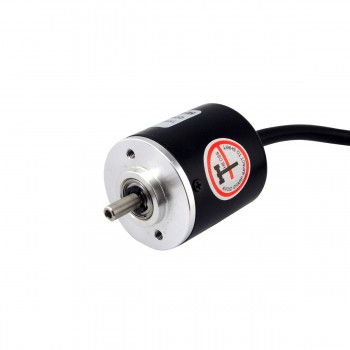
2. Main classifications of stepper motor encoders
1. The incremental encoder outputs pulse signals by detecting the change in rotational displacement, usually including A and B phase pulse outputs (phase difference of 90°) and Z phase reference position pulses. A and B phases are used to determine the direction and speed of rotation, and Z phase is used to locate the reference point. It is characterized by simple structure and strong anti-interference, but it cannot directly output absolute position information.
2. The absolute encoder directly outputs a digital signal corresponding to the position, and the absolute position can be read without an external counter. Its code disk adopts binary encoding, and outputs a fixed value corresponding to the current position when rotating, which is suitable for application scenarios that require precise control.
3. Main features of stepper motor encoders
1. Closed-loop feedback control: By real-time monitoring of the position information of the motor rotor, the feedback signal is transmitted to the control system to achieve closed-loop regulation. This closed-loop control method significantly improves the stability and response speed of the system, especially in high-speed or high-load scenarios, it can effectively avoid loss of step and vibration problems.
2. Accurate positioning and speed monitoring: The encoder converts mechanical displacement into electrical signals with an accuracy of 0.01°~0.001°, and supports high-speed (up to 25,000 rpm) operation. Incremental encoders achieve precise positioning through pulse counting, while absolute encoders can store full-stroke position data and retain memory after power failure.
3. Strong anti-interference and adaptability: Using magnetic or optical sensor technology, it can work stably in harsh environments (such as vibration and dust). The closed-loop system effectively responds to sudden load changes and temperature changes by adjusting the control strategy in real time.
4. Simplified debugging and maintenance: Simplify the integration process through standardized interfaces (such as SPI, PWM) and support multi-axis synchronous control. Some models support automatic calibration function to reduce debugging complexity.
5. High efficiency and low loss: The closed-loop system efficiency can reach 3~7 times that of ordinary stepper motors, and the output power is increased by 2~3 times. The low vibration and low noise design makes it more suitable for precision equipment, such as automated production lines, medical equipment, drones, etc.
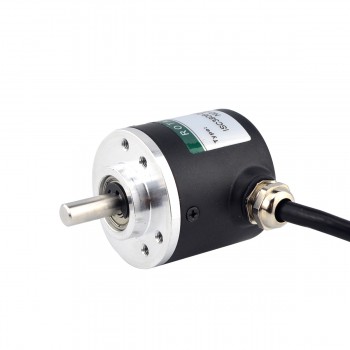
4. Tips for selecting stepper motor encoders
1. Resolution and accuracy requirements: The resolution of the encoder (such as 100, 200, 400 PPR) directly affects the positioning accuracy. High resolution (such as 1000 PPR or above) is suitable for precision machining equipment. The accuracy is measured in arc seconds or arc minutes, and it needs to match the error requirements of the motor control system.
2. Output signal type and interface: Incremental encoders output A/B/Z phase pulse signals, which are suitable for speed closed-loop control; absolute encoders output binary or Gray code, support power-off memory, and are suitable for position closed-loop control. The interface protocol must be compatible with the driver (such as EtherCAT, CANopen, etc.).
3. Mechanical and environmental adaptability: The shaft load capacity needs to match the vibration intensity of the equipment (such as radial load 200N), the protection level IP65/67 is suitable for conventional environments, and IP69K is suitable for high-pressure washing scenarios. The operating temperature range is usually -20℃~+80℃, and the wide temperature model can reach -40℃~+100℃.
4. Dynamic performance matching: The maximum speed needs to match the motor load (such as the stepper motor speed 1000~1200 RPM), and the subdivision technology can improve the resolution but the original engraving accuracy must be ensured. The dynamic response capability needs to adapt to the acceleration change to avoid signal loss.
5. Cost and maintenance: The incremental cost is lower but requires regular calibration, and the absolute long-term maintenance cost is higher. Cost performance requires comprehensive performance, technical support and after-sales guarantee.
Source:https://www.tumblr.com/raysteppermotor/788764997953208320/main-features-and-selection-tips-of-stepper-motor
The photoelectric sensor inside the stepper motor encoder rotates synchronously with the motor shaft, and generates pulse signals by blocking the light source through the light-transmitting slots on the grating disk. After processing, these pulse signals can calculate the real-time position, speed and direction of the motor. The incremental encoder determines the direction of rotation by the phase difference between the A and B phase pulses (A leads B for clockwise), and the Z phase pulse is used to locate the reference point.
2. Main classifications of stepper motor encoders
1. The incremental encoder outputs pulse signals by detecting the change in rotational displacement, usually including A and B phase pulse outputs (phase difference of 90°) and Z phase reference position pulses. A and B phases are used to determine the direction and speed of rotation, and Z phase is used to locate the reference point. It is characterized by simple structure and strong anti-interference, but it cannot directly output absolute position information.
2. The absolute encoder directly outputs a digital signal corresponding to the position, and the absolute position can be read without an external counter. Its code disk adopts binary encoding, and outputs a fixed value corresponding to the current position when rotating, which is suitable for application scenarios that require precise control.
3. Main features of stepper motor encoders
1. Closed-loop feedback control: By real-time monitoring of the position information of the motor rotor, the feedback signal is transmitted to the control system to achieve closed-loop regulation. This closed-loop control method significantly improves the stability and response speed of the system, especially in high-speed or high-load scenarios, it can effectively avoid loss of step and vibration problems.
2. Accurate positioning and speed monitoring: The encoder converts mechanical displacement into electrical signals with an accuracy of 0.01°~0.001°, and supports high-speed (up to 25,000 rpm) operation. Incremental encoders achieve precise positioning through pulse counting, while absolute encoders can store full-stroke position data and retain memory after power failure.
3. Strong anti-interference and adaptability: Using magnetic or optical sensor technology, it can work stably in harsh environments (such as vibration and dust). The closed-loop system effectively responds to sudden load changes and temperature changes by adjusting the control strategy in real time.
4. Simplified debugging and maintenance: Simplify the integration process through standardized interfaces (such as SPI, PWM) and support multi-axis synchronous control. Some models support automatic calibration function to reduce debugging complexity.
5. High efficiency and low loss: The closed-loop system efficiency can reach 3~7 times that of ordinary stepper motors, and the output power is increased by 2~3 times. The low vibration and low noise design makes it more suitable for precision equipment, such as automated production lines, medical equipment, drones, etc.
4. Tips for selecting stepper motor encoders
1. Resolution and accuracy requirements: The resolution of the encoder (such as 100, 200, 400 PPR) directly affects the positioning accuracy. High resolution (such as 1000 PPR or above) is suitable for precision machining equipment. The accuracy is measured in arc seconds or arc minutes, and it needs to match the error requirements of the motor control system.
2. Output signal type and interface: Incremental encoders output A/B/Z phase pulse signals, which are suitable for speed closed-loop control; absolute encoders output binary or Gray code, support power-off memory, and are suitable for position closed-loop control. The interface protocol must be compatible with the driver (such as EtherCAT, CANopen, etc.).
3. Mechanical and environmental adaptability: The shaft load capacity needs to match the vibration intensity of the equipment (such as radial load 200N), the protection level IP65/67 is suitable for conventional environments, and IP69K is suitable for high-pressure washing scenarios. The operating temperature range is usually -20℃~+80℃, and the wide temperature model can reach -40℃~+100℃.
4. Dynamic performance matching: The maximum speed needs to match the motor load (such as the stepper motor speed 1000~1200 RPM), and the subdivision technology can improve the resolution but the original engraving accuracy must be ensured. The dynamic response capability needs to adapt to the acceleration change to avoid signal loss.
5. Cost and maintenance: The incremental cost is lower but requires regular calibration, and the absolute long-term maintenance cost is higher. Cost performance requires comprehensive performance, technical support and after-sales guarantee.
Source:https://www.tumblr.com/raysteppermotor/788764997953208320/main-features-and-selection-tips-of-stepper-motor