

Design technology and control method of hollow rotary actuators
1. Working principle of hollow rotary actuators
The working principle of hollow rotary actuators involves drive and transmission mechanisms. Taking motor-gear transmission as an example, the motor starts to rotate after power is turned on, and the power is transmitted to the small gear through the coupling. The small gear meshes with the large gear to achieve speed conversion, thereby driving the turntable to rotate at the set speed. The principle of hydraulic or pneumatic drive is similar, and the rotational motion is achieved through a hydraulic cylinder or a cylinder.
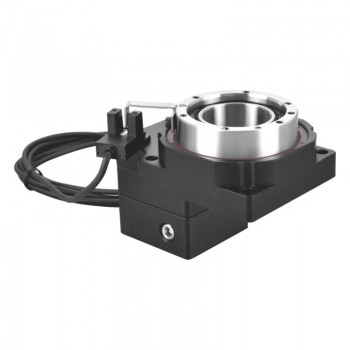
2. Main structural components of hollow rotary actuators
1. Motor: Hollow rotary actuators usually use motors as power sources. Common ones include frameless torque motors. This type of motor has the characteristics of high efficiency and stability, and is suitable for scenarios that require high-precision control.
2. Reducer: The reducer plays the role of reducing the speed and increasing the torque in the hollow rotary actuator. Commonly used reducers include harmonic reducers and planetary reducers. Harmonic reducers have the advantages of small size, light weight and high precision, and are suitable for humanoid robot actuators; while planetary reducers are often used in joints with low precision requirements due to their low price and strong load-bearing capacity.
3. Sensors: Sensors are used to detect position and torque information in hollow rotary actuators. Common sensors include position sensors and force/torque sensors. These sensors can provide real-time feedback information to help the control system make precise adjustments.
4. Controller: The controller is responsible for receiving information fed back by the sensor and controlling the motor and reducer according to preset parameters. The controller is usually used in conjunction with an encoder to ensure the motion accuracy and stability of the actuator.
5. Encoder: The encoder is used to measure the angle and position of the rotary actuator and provide accurate position feedback. Common encoders include absolute encoders, which can provide high-precision position information.
3. Design technology of hollow rotary actuators
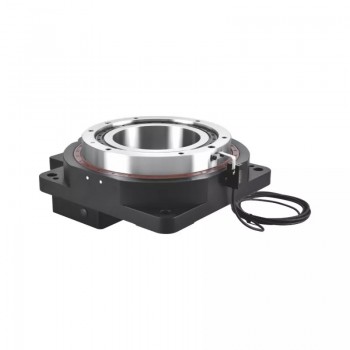
1. Hollow design: The core feature of the hollow rotary actuator is that its center part is hollow, which allows the workpiece to pass directly through the center of the actuator, thereby freeing up the freedom of motion of the robot end effector. This design performs well in narrow spaces or complex working conditions, and can flexibly shuttle between machine tool working areas to achieve non-interference handling of large body parts.
2. Multimodal sensing technology: Hollow rotary actuators are usually equipped with AI vision and force feedback systems, and realize "hand-eye-brain" collaborative operation through multimodal sensing technology. For example, the built-in 3D vision sensor can scan the contour of the workpiece in real time, dynamically adjust the gripping angle and force, and complete the optimal path planning in a short time even when facing stacked and scattered metal parts.
3. High-precision control: Hollow rotary actuators usually have high-precision control capabilities. For example, its repeatable positioning accuracy can reach ±0.01mm, and it can accurately grasp a 0.5mm thick flexible circuit board, solving the industry pain point that small workpieces are easy to slip. In addition, the force control algorithm can control the clamping force error within ±0.5N, which is suitable for precision assembly scenarios.
4. Modular design: Hollow rotary actuators usually adopt modular design, which is convenient for rapid changeover and adaptation to different application scenarios. For example, the gripper head supports magnetic quick release, and can complete the tooling switch from grabbing the middle frame of the mobile phone to the car bumper within 3 minutes.
5. Intelligent debugging and maintenance: By building a virtual debugging environment through digital twin technology, the equipment debugging cycle can be shortened by 60%, and remote predictive maintenance can be supported to reduce the company's downtime costs.
4. Control method of hollow rotary actuator
1. PID control: PID control is a common control method that adjusts the output of the controller through three parameters: proportion (P), integral (I), and differential (D) to achieve precise control of the system. The PID controller can adjust the output according to the error value to make the system reach a stable state.
2. Fuzzy control: Fuzzy control is a control method based on fuzzy logic, which is suitable for systems where it is difficult to establish an accurate mathematical model. By defining the fuzzy set of input and output and the corresponding rules, the fuzzy controller can make decisions based on the input fuzzy information, which is suitable for processing uncertainty and imprecise information.
3. Adaptive control: Adaptive control can automatically adjust the control parameters according to the changes in the system, and is suitable for systems with large dynamic changes. By monitoring the state of the system in real time, the adaptive controller can adjust its control strategy to adapt to different working conditions.
4. Feedforward control: Feedforward control is a model-based control method that predicts the input and output relationship of the system and adjusts the controller output in advance to reduce the system response time and improve the stability of the system. Feedforward control is suitable for systems that can accurately establish mathematical models.
5. Composite control: Composite control is the combination of multiple control methods to fully utilize the advantages of various control methods. For example, PID control and fuzzy control can be combined to form a PID-fuzzy controller to improve the robustness and adaptability of the system.
The working principle of hollow rotary actuators involves drive and transmission mechanisms. Taking motor-gear transmission as an example, the motor starts to rotate after power is turned on, and the power is transmitted to the small gear through the coupling. The small gear meshes with the large gear to achieve speed conversion, thereby driving the turntable to rotate at the set speed. The principle of hydraulic or pneumatic drive is similar, and the rotational motion is achieved through a hydraulic cylinder or a cylinder.
2. Main structural components of hollow rotary actuators
1. Motor: Hollow rotary actuators usually use motors as power sources. Common ones include frameless torque motors. This type of motor has the characteristics of high efficiency and stability, and is suitable for scenarios that require high-precision control.
2. Reducer: The reducer plays the role of reducing the speed and increasing the torque in the hollow rotary actuator. Commonly used reducers include harmonic reducers and planetary reducers. Harmonic reducers have the advantages of small size, light weight and high precision, and are suitable for humanoid robot actuators; while planetary reducers are often used in joints with low precision requirements due to their low price and strong load-bearing capacity.
3. Sensors: Sensors are used to detect position and torque information in hollow rotary actuators. Common sensors include position sensors and force/torque sensors. These sensors can provide real-time feedback information to help the control system make precise adjustments.
4. Controller: The controller is responsible for receiving information fed back by the sensor and controlling the motor and reducer according to preset parameters. The controller is usually used in conjunction with an encoder to ensure the motion accuracy and stability of the actuator.
5. Encoder: The encoder is used to measure the angle and position of the rotary actuator and provide accurate position feedback. Common encoders include absolute encoders, which can provide high-precision position information.
3. Design technology of hollow rotary actuators
1. Hollow design: The core feature of the hollow rotary actuator is that its center part is hollow, which allows the workpiece to pass directly through the center of the actuator, thereby freeing up the freedom of motion of the robot end effector. This design performs well in narrow spaces or complex working conditions, and can flexibly shuttle between machine tool working areas to achieve non-interference handling of large body parts.
2. Multimodal sensing technology: Hollow rotary actuators are usually equipped with AI vision and force feedback systems, and realize "hand-eye-brain" collaborative operation through multimodal sensing technology. For example, the built-in 3D vision sensor can scan the contour of the workpiece in real time, dynamically adjust the gripping angle and force, and complete the optimal path planning in a short time even when facing stacked and scattered metal parts.
3. High-precision control: Hollow rotary actuators usually have high-precision control capabilities. For example, its repeatable positioning accuracy can reach ±0.01mm, and it can accurately grasp a 0.5mm thick flexible circuit board, solving the industry pain point that small workpieces are easy to slip. In addition, the force control algorithm can control the clamping force error within ±0.5N, which is suitable for precision assembly scenarios.
4. Modular design: Hollow rotary actuators usually adopt modular design, which is convenient for rapid changeover and adaptation to different application scenarios. For example, the gripper head supports magnetic quick release, and can complete the tooling switch from grabbing the middle frame of the mobile phone to the car bumper within 3 minutes.
5. Intelligent debugging and maintenance: By building a virtual debugging environment through digital twin technology, the equipment debugging cycle can be shortened by 60%, and remote predictive maintenance can be supported to reduce the company's downtime costs.
4. Control method of hollow rotary actuator
1. PID control: PID control is a common control method that adjusts the output of the controller through three parameters: proportion (P), integral (I), and differential (D) to achieve precise control of the system. The PID controller can adjust the output according to the error value to make the system reach a stable state.
2. Fuzzy control: Fuzzy control is a control method based on fuzzy logic, which is suitable for systems where it is difficult to establish an accurate mathematical model. By defining the fuzzy set of input and output and the corresponding rules, the fuzzy controller can make decisions based on the input fuzzy information, which is suitable for processing uncertainty and imprecise information.
3. Adaptive control: Adaptive control can automatically adjust the control parameters according to the changes in the system, and is suitable for systems with large dynamic changes. By monitoring the state of the system in real time, the adaptive controller can adjust its control strategy to adapt to different working conditions.
4. Feedforward control: Feedforward control is a model-based control method that predicts the input and output relationship of the system and adjusts the controller output in advance to reduce the system response time and improve the stability of the system. Feedforward control is suitable for systems that can accurately establish mathematical models.
5. Composite control: Composite control is the combination of multiple control methods to fully utilize the advantages of various control methods. For example, PID control and fuzzy control can be combined to form a PID-fuzzy controller to improve the robustness and adaptability of the system.